


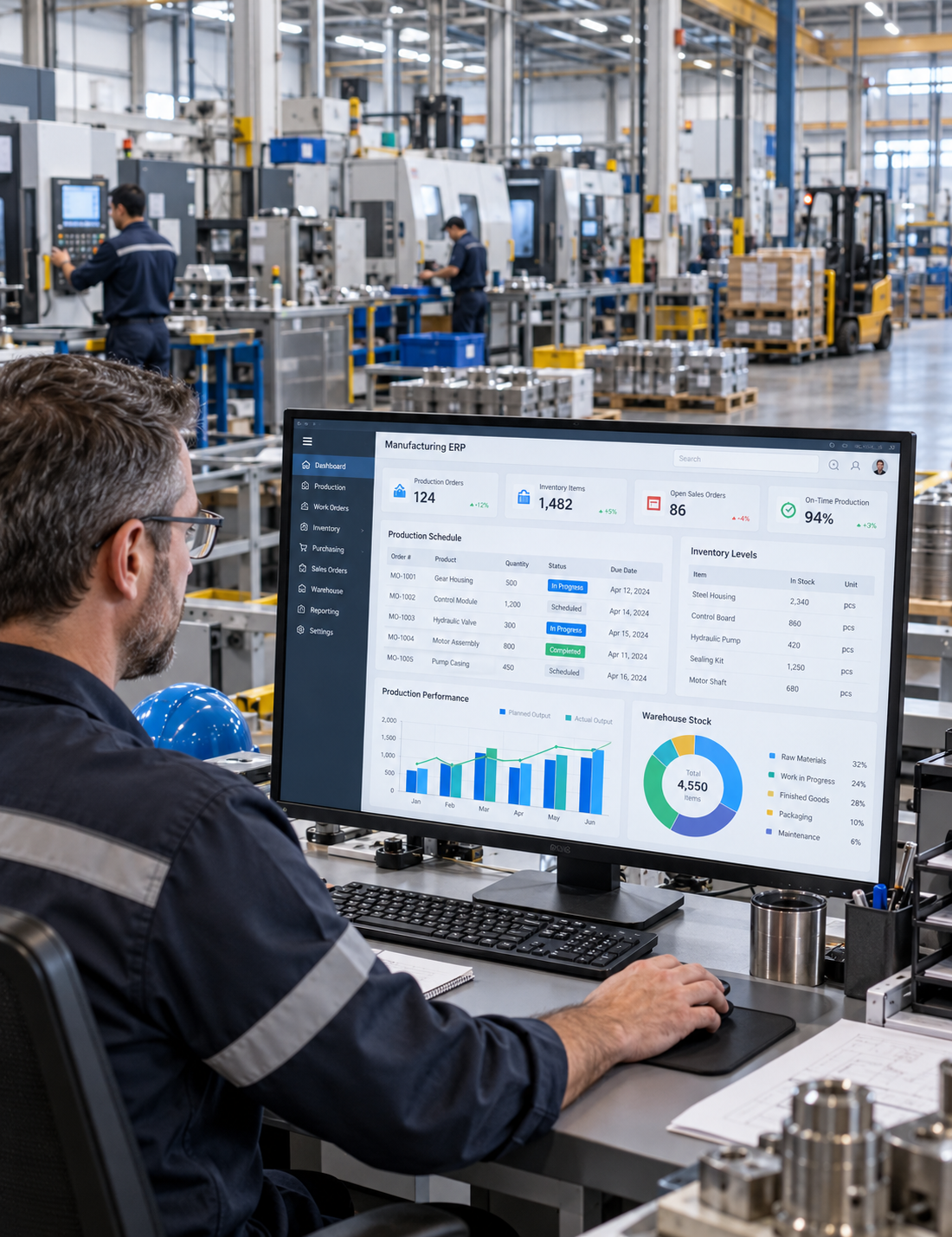
ERP System Implementation: Unifying Fragmented Legacy Workflows into a Scalable, Next-Gen Enterprise Resource Planning Ecosystem
Disjointed business software, disconnected accounting spreadsheets, and fragmented supply chain databases limit operational agility and hinder growth. Our client—a multi-site manufacturing and distribution enterprise—struggled with disparate standalone platforms, redundant manual entry across departments, inaccurate inventory reporting, and delayed month-end financial reconciliations.
The Challenge
Prior to partnering with Cyber Skill Nexus, the enterprise encountered severe functional bottlenecks across administrative and production lines:
- Siloed Data & Manual Redundancy: Sales, procurement, warehouse stock, and finance operated on isolated systems, resulting in continuous human error, duplicate data entry, and inconsistent records.
- Lack of Real-Time Supply Chain Visibility: Warehouse managers had no live inventory visibility across regional fulfillment centers, causing recurring stockouts, dispatch delays, and customer dissatisfaction.
- Lengthy Financial Close Cycles: Aggregating cross-departmental records for balance sheets and compliance auditing took up to 18 business days every month due to absent automated reconciliation pipelines.
"Cyber Skill Nexus transformed our operational back-bone. By consolidating our finance, supply chain, and production into one centralized ERP platform, our order processing time dropped by 65% and month-end closes now take hours instead of weeks."
Chief Operating Officer, Apex Manufacturing & Logistics
The Solution & Technical Roadmap
Cyber Skill Nexus engineered and executed a comprehensive, modular ERP deployment with zero interruption to ongoing operations:
- Unified Cloud ERP Core Architecture: Architected a single-source-of-truth ERP database connecting Procurement, Inventory, Human Resources, CRM, and General Ledger modules with automated data cleansing and legacy migration.
- Real-Time API & Barcode Integration: Integrated automated barcode scanners and IoT-enabled warehouse sensors directly into the ERP pipeline, providing instant live tracking from factory intake to retail delivery.
- Automated Workflows & Role-Based Security: Configured automated purchase order approvals, dynamic ledger balance validations, and strict Role-Based Access Controls (RBAC) to ensure complete audit compliance and data integrity.
Business Impact & Outcomes
75%
Faster Financial Reporting & Close
40%
Operational Cost & Waste Reduction
99.8%
Real-Time Inventory Tracking Accuracy
Implementing an integrated, cloud-native ERP architecture eliminates operational blind spots, breaks down cross-departmental silos, and positions growing businesses to make data-driven decisions at enterprise scale.